
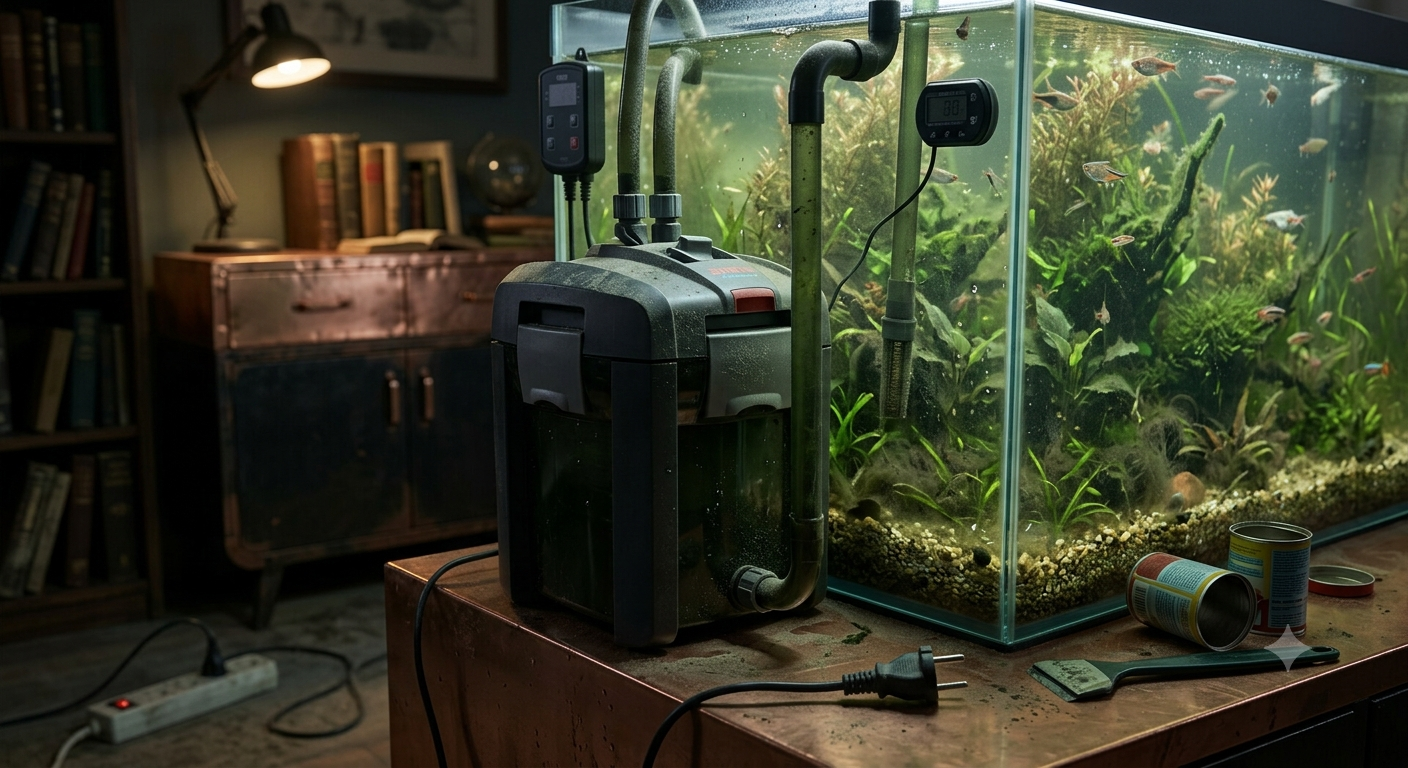
What Happens If Your Aquarium Filter Stops Working? (Emergency Guide)
Imagine waking up in the morning, walking over to your aquarium, and immediately noticing something is wrong.
The gentle humming sound that usually fills the room has disappeared. The water surface is perfectly still. Your filter isn’t running.
Your first thought is probably one of panic:
“Are my fish going to die?”
It’s a situation that almost every aquarium owner experiences at least once. Sometimes it’s caused by a power outage during the night. Sometimes an old filter motor simply reaches the end of its life. Other times, a clogged impeller or blocked intake silently stops the flow of water.
Whatever the cause, seeing your aquarium filter stop working can be stressful, especially if you’re new to fishkeeping.
The good news is that a stopped filter is not an immediate death sentence for your fish.
Most healthy aquariums have a window of time where the fish can survive safely before water quality begins to decline. How long that window lasts depends on several important factors, including the size of the aquarium, the number of fish, water temperature, and whether the beneficial bacteria inside your filter remain alive.
The key is knowing what to do immediately and avoiding the common mistakes that make the situation worse.
In this guide, you’ll learn exactly what happens inside your aquarium when a filter stops working, how long fish can realistically survive, and the emergency steps that can keep your aquarium stable until filtration is restored.
Whether your filter has just stopped unexpectedly or you’re simply preparing for future emergencies, this guide will help you respond with confidence instead of panic.
The Short Answer
If your aquarium filter stops working, don’t panic.
Most fish can survive several hours and often up to 24 hours without filtration if the aquarium is healthy and not overcrowded. However, the longer the filter remains off, the greater the risk of oxygen depletion, ammonia buildup, and damage to the beneficial bacteria that keep the tank biologically stable.
Your priorities should be:
- Restore water movement as soon as possible.
- Keep oxygen levels high.
- Avoid feeding your fish.
- Monitor fish behaviour closely.
- Restart or replace the filter as quickly as possible.
If you act quickly, most aquariums recover without long-term problems.
Why Your Aquarium Filter Is More Important Than You Think
Many beginners believe that an aquarium filter has only one job: making the water look clean.
That isn’t actually its most important role.
A filter is constantly working behind the scenes to maintain the invisible balance that keeps fish healthy.
Every second your aquarium filter is running, it is doing several jobs at once.
It removes floating debris before it settles on the bottom of the tank.
It circulates water, preventing stagnant areas where oxygen levels can drop.
Most importantly, it provides a home for millions of beneficial bacteria that convert toxic ammonia into safer compounds through the nitrogen cycle.
When the filter suddenly stops, all of these processes begin slowing down.
Not immediately—but gradually.
This is why a stopped filter becomes more dangerous the longer it remains off.
What Actually Happens the Moment Your Filter Stops?
One of the biggest misconceptions is that fish are instantly in danger the second the filter turns off.
Fortunately, that’s not what happens.
Instead, several changes begin occurring inside the aquarium over time.
Understanding these changes helps explain why quick action matters.
The Water Stops Moving
The first thing you’ll notice is that the water becomes still.
This might not seem like a major issue, but surface movement is responsible for one of the most important processes in the aquarium.
As water ripples across the surface, oxygen enters the tank while carbon dioxide escapes.
When movement stops, this exchange becomes much slower.
Fish don’t breathe the bubbles produced by filters or air stones. They breathe oxygen that has already dissolved into the water.
Without continuous surface agitation, dissolved oxygen begins decreasing.
In a lightly stocked aquarium, this happens gradually.
In a crowded aquarium or during hot weather, oxygen levels can fall surprisingly quickly.
Oxygen Levels Begin Falling
One of the first invisible changes is a slow reduction in dissolved oxygen.
Every living thing inside the aquarium consumes oxygen.
This includes:
- Fish
- Shrimp
- Snails
- Beneficial bacteria
- Live plants during the night
Because oxygen is constantly being used, it must also be continuously replaced.
Normally, your filter helps accomplish this by disturbing the water surface.
Without that movement, oxygen enters the aquarium much more slowly than it is being consumed.
This explains why fish often begin gathering near the surface after long power outages.
They’re searching for areas where oxygen concentration is slightly higher.
Beneficial Bacteria Lose Their Oxygen Supply
Most aquarium owners worry about the fish.
Experienced aquarists often worry about something else first.
The beneficial bacteria.
These bacteria live mainly inside your filter media because flowing, oxygen-rich water constantly passes over them.
When the filter stops, fresh oxygen no longer reaches the bacterial colony.
For a few hours, this usually isn’t a serious problem.
However, after longer periods, some bacteria begin dying.
This weakens the aquarium’s ability to process ammonia once the filter starts again.
In other words, even after electricity returns, the biological filter may not immediately recover.
This is one reason long power outages sometimes lead to ammonia spikes several days later.
Waste Continues Building Up
One thing never stops inside an aquarium.
Your fish continue producing waste.
Every fish breathes, eats, digests food, and releases ammonia into the water.
The filter doesn’t create the waste.
It simply helps process it.
Without filtration, ammonia production continues while waste processing slows.
Initially, the existing bacterial colony can often keep up.
Eventually, however, harmful compounds begin accumulating.
This is why feeding fish during a filter failure usually makes the situation worse.
More food creates more waste.
More waste creates more ammonia.
More ammonia places additional stress on fish that are already dealing with reduced oxygen.
How Long Can Fish Survive Without a Filter?
This is one of the most common questions asked by aquarium owners.
Unfortunately, there isn’t a single answer.
A healthy 75-gallon planted aquarium behaves very differently from a crowded 10-gallon beginner tank.
Several factors determine how long fish can survive.
Tank Size
Generally speaking, larger aquariums remain stable for longer.
Why?
Because larger water volumes dilute waste more effectively.
Imagine adding one drop of food colouring into a swimming pool.
Now imagine adding that same drop into a drinking glass.
The concentration changes dramatically.
Aquariums work in exactly the same way.
A larger tank gives you more time to respond before water quality becomes dangerous.
Number of Fish
Stocking density may be the biggest factor affecting survival.
A lightly stocked aquarium:
- Produces less waste
- Uses less oxygen
- Experiences slower ammonia buildup
A heavily stocked aquarium can consume available oxygen much faster.
This is why two aquariums of the same size can have completely different survival times after a filter failure.
Water Temperature
Temperature plays a surprisingly important role.
Warm water naturally holds less dissolved oxygen than cooler water.
At the same time, fish become more active as temperatures rise, increasing their oxygen demand.
This combination makes summer power outages particularly dangerous.
If your aquarium reaches temperatures above 28°C (82°F), oxygen depletion may occur much faster than expected.
Live Plants
Many people assume plants completely solve oxygen problems.
The reality is a little more complicated.
During daylight, healthy aquatic plants release oxygen through photosynthesis.
This can slightly improve oxygen levels.
However, once the lights go off, plants begin consuming oxygen just like fish.
In heavily planted aquariums, nighttime oxygen shortages can actually become more noticeable if there is no water movement.
Plants are incredibly beneficial, but they are not a replacement for proper circulation.
Fish Species Matter
Some fish tolerate temporary filter failures much better than others.
For example, betta fish possess a labyrinth organ that allows them to breathe atmospheric air.
This gives them an advantage during periods of low dissolved oxygen.
Goldfish, on the other hand, produce large amounts of waste.
Although they are often considered hardy, they actually place much greater demands on filtration than many tropical species.
Sensitive fish such as discus, certain dwarf cichlids, and some marine species may begin showing stress much sooner because they rely on exceptionally stable water conditions.
Understanding the needs of the fish you keep helps you judge how urgently you need to respond when filtration stops.
The First Hour: What You Should Do Immediately
The first hour after discovering a filter failure is usually the most important.
Fortunately, the steps are straightforward.
The first thing you should do is stay calm.
Rushing into unnecessary actions often causes more problems than the filter failure itself.
Begin by checking the obvious.
Is the power supply working?
Has a circuit breaker tripped?
Has the plug accidentally become loose?
If you’re using an external canister filter, check whether the hoses are kinked or whether the filter simply needs to be primed again.
For hang-on-back filters, a drop in water level can sometimes prevent the impeller from restarting after a power interruption.
Many “broken” filters are actually simple maintenance issues that can be fixed within a few minutes.
Once you’ve checked the equipment, observe your fish.
If they are swimming normally, breathing comfortably, and not gathering at the surface, you probably have time to troubleshoot carefully.
If fish are already gasping for air, your priority shifts immediately toward increasing oxygen and restoring water movement.
The Biggest Mistakes People Make When Their Aquarium Filter Stops Working
When an aquarium filter suddenly stops, most fish don’t die because the filter failed.
They die because well-meaning owners panic and make decisions that unintentionally create even more stress.
Understanding what not to do is just as important as knowing the correct emergency steps.
Let’s look at the most common mistakes and why they should be avoided.
Mistake 1: Feeding Your Fish
One of the first instincts many people have is to feed their fish, thinking they need extra energy to cope with the stressful situation.
In reality, feeding is one of the worst things you can do.
Every meal your fish eat eventually becomes waste. That waste breaks down into ammonia, which is already becoming harder for the aquarium to process while the filter is off.
Healthy adult fish can comfortably go several days without food. In nature, many species regularly experience periods without eating.
By skipping feeding during a filter failure, you’re actually helping your fish by slowing down ammonia production.
Once the filter is working normally again and the aquarium is stable, you can gradually return to your regular feeding schedule.
Mistake 2: Replacing All the Water
Seeing your filter stop often makes people think the water itself has become bad.
As a result, some owners immediately perform a 100% water change.
This usually creates more problems than it solves.
A complete water change can:
- Stress fish through sudden changes in temperature
- Cause rapid pH fluctuations
- Alter water hardness
- Remove helpful microorganisms suspended in the water
- Shock already stressed fish
Instead, perform small partial water changes if necessary.
Replacing around 20–30% of the water is usually enough to dilute ammonia without drastically changing the aquarium environment.
Remember, stability is almost always better than dramatic changes.
Mistake 3: Cleaning Everything at Once
Another common reaction is deciding it’s the perfect time to clean the entire aquarium.
The gravel gets vacuumed.
The decorations get scrubbed.
The filter media gets rinsed thoroughly.
Sometimes everything is cleaned using tap water.
Unfortunately, this removes large amounts of beneficial bacteria at the exact moment your aquarium needs them most.
Beneficial bacteria don’t only live inside the filter.
They also live on:
- Gravel
- Rocks
- Driftwood
- Decorations
- Aquarium glass
- Live plants
Cleaning every surface at once can significantly reduce your biological filtration.
During a filter emergency, it’s better to disturb the aquarium as little as possible.
Mistake 4: Washing Filter Media Under Tap Water
This is one of the biggest beginner mistakes in fishkeeping.
If you manage to restart your filter, you might notice the sponge or biological media looks dirty.
Your first instinct may be to rinse it thoroughly under the kitchen tap.
Don’t.
Tap water usually contains chlorine or chloramine.
These chemicals are designed to kill bacteria.
Unfortunately, they cannot tell the difference between harmful bacteria and the beneficial bacteria that keep your aquarium healthy.
If you need to clean filter media, always rinse it gently using water taken from the aquarium during a water change.
This preserves most of the beneficial bacteria while removing excess debris.
Mistake 5: Assuming Everything Is Fine Because the Water Looks Clear
This mistake catches many beginners.
You look into the aquarium.
The water is crystal clear.
The fish appear calm.
So you assume there is no urgent problem.
Unfortunately, dangerous water conditions are usually invisible.
Ammonia has no colour.
Nitrite has no colour.
Low oxygen cannot be seen.
A clear aquarium can still become chemically dangerous.
This is why experienced aquarists trust water testing and fish behaviour more than appearance.
How to Keep Fish Alive During a Long Power Outage
Power outages are one of the most common reasons aquarium filters stop working.
Sometimes electricity returns within minutes.
Other times, storms can leave homes without power for many hours or even days.
If you know the outage will be prolonged, your priorities become:
- Maintain oxygen.
- Reduce waste.
- Preserve beneficial bacteria.
Let’s look at each one.
Step 1: Keep Oxygen Levels High
Oxygen is usually the first concern during a long outage.
Without a running filter, water movement slows and oxygen exchange decreases.
One of the easiest emergency methods is manually creating surface movement.
Every hour or two, scoop aquarium water into a clean container and gently pour it back into the tank from several inches above the surface.
This simple action helps fresh oxygen dissolve into the water.
If you live in an area where storms are common, consider purchasing a battery-powered aquarium air pump.
These inexpensive devices can keep fish alive during unexpected outages and are one of the best emergency investments an aquarium owner can make.
Step 2: Reduce Waste Production
As mentioned earlier, stop feeding.
This reduces:
- Fish waste
- Ammonia production
- Oxygen consumption during digestion
Many beginners worry their fish will become hungry.
Healthy fish are much more likely to survive several days without food than several days with rising ammonia.
Step 3: Protect the Beneficial Bacteria
One thing many people forget is that beneficial bacteria also need oxygen-rich water.
If your filter remains off for many hours, the bacterial colony inside the filter media begins suffering from oxygen deprivation.
If possible, gently circulate aquarium water through the filter media occasionally.
Some aquarists carefully remove filter sponges and place them inside the aquarium where oxygenated water can continue flowing around them.
This can help preserve part of the bacterial colony until power returns.
Should You Buy a Battery Backup?
If you keep expensive fish or large aquariums, the answer is almost certainly yes.
Battery-powered air pumps are relatively inexpensive compared with replacing an entire aquarium full of fish.
For hobbyists who experience frequent storms or unreliable electricity, they’re excellent insurance.
Many experienced aquarists also keep:
- Spare heaters
- Spare filter impellers
- Extra airline tubing
- Water conditioner
- Test kits
Being prepared often turns an emergency into a minor inconvenience.
Signs Your Fish Are Running Out of Oxygen
One of the biggest advantages of observing your aquarium regularly is learning what “normal” looks like.
When oxygen begins dropping, fish usually show warning signs before conditions become critical.
Watch for:
Fish Gathering at the Surface
This is one of the clearest indicators.
Fish naturally seek areas where oxygen concentration is highest.
Since oxygen enters through the water surface, many species begin spending more time there.
Rapid Gill Movement
Healthy fish breathe steadily.
When oxygen becomes limited, they increase the speed of their gill movements to extract more oxygen from the water.
Fast breathing is often one of the earliest signs of stress.
Fish Staying Near Filter Outlets
If only a small amount of water movement remains, fish often gather nearby because oxygen concentrations are slightly higher.
Lethargy
Low oxygen affects every organ.
Fish may become:
- Less active
- Slow to respond
- Uninterested in food
- Resting more than usual
Gasping at the Surface
This is a serious warning sign.
By the time fish are repeatedly gulping air from the surface, oxygen levels are already dangerously low.
Immediate action is required.
Can Beneficial Bacteria Survive a Filter Failure?
This is a question many aquarium owners overlook.
Beneficial bacteria are remarkably resilient, but they are not indestructible.
During a short interruption lasting a few hours, most bacterial colonies remain healthy.
However, as time passes, oxygen inside the filter decreases.
Without flowing, oxygen-rich water, some bacteria begin dying.
This doesn’t necessarily mean your aquarium must cycle from the beginning.
Instead, the colony may become smaller.
When the filter restarts, it often takes time for bacterial populations to recover fully.
This is why testing ammonia for several days after a long filter outage is a good idea.
The aquarium may appear normal while biological filtration is still rebuilding.
Restarting the Filter Safely
Once power returns or you’ve repaired the filter, don’t simply plug it in and walk away.
Take a few minutes to check everything carefully.
Look for:
- Proper water flow
- Unusual noises
- Air trapped inside the filter
- Leaks
- Reduced output
If the filter has been off for a very long time, some aquarists recommend rinsing mechanical filter media with old tank water before restarting.
This removes decaying waste that accumulated while water was stagnant without destroying beneficial bacteria.
After restarting, continue observing your fish over the next several days.
The filter may be running again, but the aquarium still needs time to stabilise.
Preventing Future Filter Emergencies
Although equipment failures cannot always be avoided, many emergencies can be prevented through regular maintenance.
A simple monthly routine can significantly reduce the chance of unexpected breakdowns.
This includes:
- Cleaning the impeller and impeller well
- Removing debris from intake tubes
- Checking hoses for blockages
- Inspecting power cables
- Replacing worn parts before they fail
- Ensuring the filter output remains strong
Many filter failures happen gradually rather than suddenly.
A filter that becomes noisier, slower, or produces weaker flow is often warning you that maintenance is overdue.
Paying attention to these small changes can prevent much larger problems later.
Emergency Aquarium Filter Failure Checklist
If your aquarium filter suddenly stops working, it’s easy to panic and forget what to do first. Save this checklist or bookmark this page so you can quickly work through the steps during an emergency.
Within the first 15 minutes:
- Stay calm and observe your fish.
- Check whether the filter is unplugged or if the power supply has failed.
- Inspect the filter for obvious issues like a clogged intake, blocked impeller, or trapped air.
- If the problem is a power outage, prepare to increase water movement manually.
Within the first hour:
- Stop feeding your fish.
- Increase surface agitation by gently pouring aquarium water back into the tank every hour or two.
- If available, connect a battery-powered air pump.
- Monitor fish closely for signs of oxygen stress.
If the filter will be off for more than 12–24 hours:
- Perform a 20–30% water change using dechlorinated water if ammonia is suspected to be rising.
- Test ammonia and nitrite if you have a water test kit.
- Keep the aquarium lights off or dim to reduce stress.
- Continue monitoring fish behaviour every few hours.
Following these simple steps can dramatically improve your fish’s chances of staying healthy until filtration is restored.
Common Questions About Aquarium Filter Failures
Will my fish die if the filter is off for one night?
In most healthy aquariums, the answer is no.
A single night without filtration is usually not enough to cause serious problems, especially in larger tanks that are lightly stocked.
However, if the aquarium is small, overcrowded, or already has poor water quality, fish may begin showing signs of stress much sooner.
The important thing is to restore filtration as quickly as possible and continue observing your fish over the following few days.
How long can beneficial bacteria survive without water flow?
Beneficial bacteria do not disappear the moment a filter stops.
In most cases, they survive several hours without major losses.
However, if the filter remains off for an extended period, oxygen inside the filter media gradually becomes depleted.
Some bacteria begin dying, reducing the filter’s biological capacity.
This is why ammonia spikes sometimes occur after the filter starts working again.
Should I replace my filter media after a filter failure?
Usually, no.
Many beginners think old filter media should be replaced after a breakdown.
In reality, your filter media contains the beneficial bacteria that your aquarium depends on.
Unless the media is physically falling apart, it should generally be reused.
Replacing all filter media at once can remove much of your biological filtration and force the aquarium to cycle again.
My filter is running again. Is everything back to normal?
Not necessarily.
Even after the filter starts working, continue checking your aquarium over the next several days.
Watch for:
- Fish breathing faster than normal
- Cloudy water
- Reduced appetite
- Ammonia or nitrite readings above zero
The mechanical part of the filter may be working immediately, but the beneficial bacteria sometimes need time to recover after a long interruption.
Can I use an air pump instead of a filter?
An air pump helps improve oxygen levels, but it does not replace a filter.
A filter performs several important jobs, including:
- Housing beneficial bacteria
- Removing debris from the water
- Circulating water throughout the aquarium
- Supporting the nitrogen cycle
An air pump only improves oxygen exchange.
Ideally, an aquarium should have both good filtration and adequate water movement.
When Should You Replace Your Aquarium Filter?
Not every filter failure means you need to buy a new one.
Many problems are inexpensive to fix.
Consider replacing the entire filter if:
- The motor no longer starts after troubleshooting.
- Replacement parts are unavailable.
- The filter repeatedly stops working.
- Water flow remains weak even after cleaning.
- The filter is too small for your aquarium.
If your aquarium has grown over time, upgrading to a larger filter can improve water quality and provide a greater safety margin.
As a general rule, choosing a filter rated for a tank slightly larger than your aquarium often provides better biological filtration and more stable water conditions.
How to Prevent Future Filter Problems
While no filter lasts forever, regular maintenance can significantly reduce the chance of unexpected failures.
A simple monthly routine can make a big difference.
Take a few minutes to:
- Clean the impeller and impeller housing.
- Remove debris from the intake tube.
- Check that water flow remains strong.
- Inspect airline tubing and hoses for blockages.
- Ensure the power cable is in good condition.
- Replace worn seals or damaged parts before they fail.
Many filters don’t suddenly stop working—they gradually lose performance over weeks or months.
If you notice weaker water flow, unusual noises, or frequent restarting, treat these as warning signs rather than waiting for a complete failure.
A little preventive maintenance is often far cheaper than replacing fish or rebuilding a crashed aquarium.
Final Thoughts
Discovering that your aquarium filter has stopped working can be alarming, but it doesn’t have to become a disaster.
The most important thing to remember is that time is on your side—at least initially.
Fish don’t usually die the moment a filter stops. What matters is how you respond over the next few hours.
By keeping the water oxygenated, avoiding unnecessary feeding, monitoring water quality, and restoring filtration as quickly as possible, you can often prevent long-term damage to both your fish and the beneficial bacteria that keep your aquarium healthy.
Perhaps the biggest lesson is that an aquarium filter does much more than make the water look clean.
It quietly supports the entire ecosystem inside your tank every minute of every day.
That’s why regular maintenance, routine inspections, and having a simple emergency plan are so valuable. They don’t just protect your equipment—they protect the living animals that depend on it.
If you’re new to fishkeeping, don’t let this topic scare you. Equipment failures happen to almost every aquarist sooner or later.
The difference between a stressful experience and a successful recovery usually comes down to being prepared.
Now that you know what to do, you’ll be able to act confidently if your filter ever stops working.
Continue Learning
If you found this guide helpful, these articles will help you better understand aquarium filtration and fish health:
- Can Fish Live Without a Filter? (Honest Answer) – Learn when fish can survive without filtration, why filters are so important, and whether a filterless aquarium is ever a good idea.
- Can Fish Live Without an Oxygen Pump? – Discover how oxygen enters your aquarium, when an air pump is necessary, and the warning signs of low oxygen levels.
- The importance of water quality in an Aquarium – Find out why water quality is highly important for your aquarium species.
Learning how filtration, oxygen, and water quality work together will make you a more confident and successful aquarium keeper.
)