
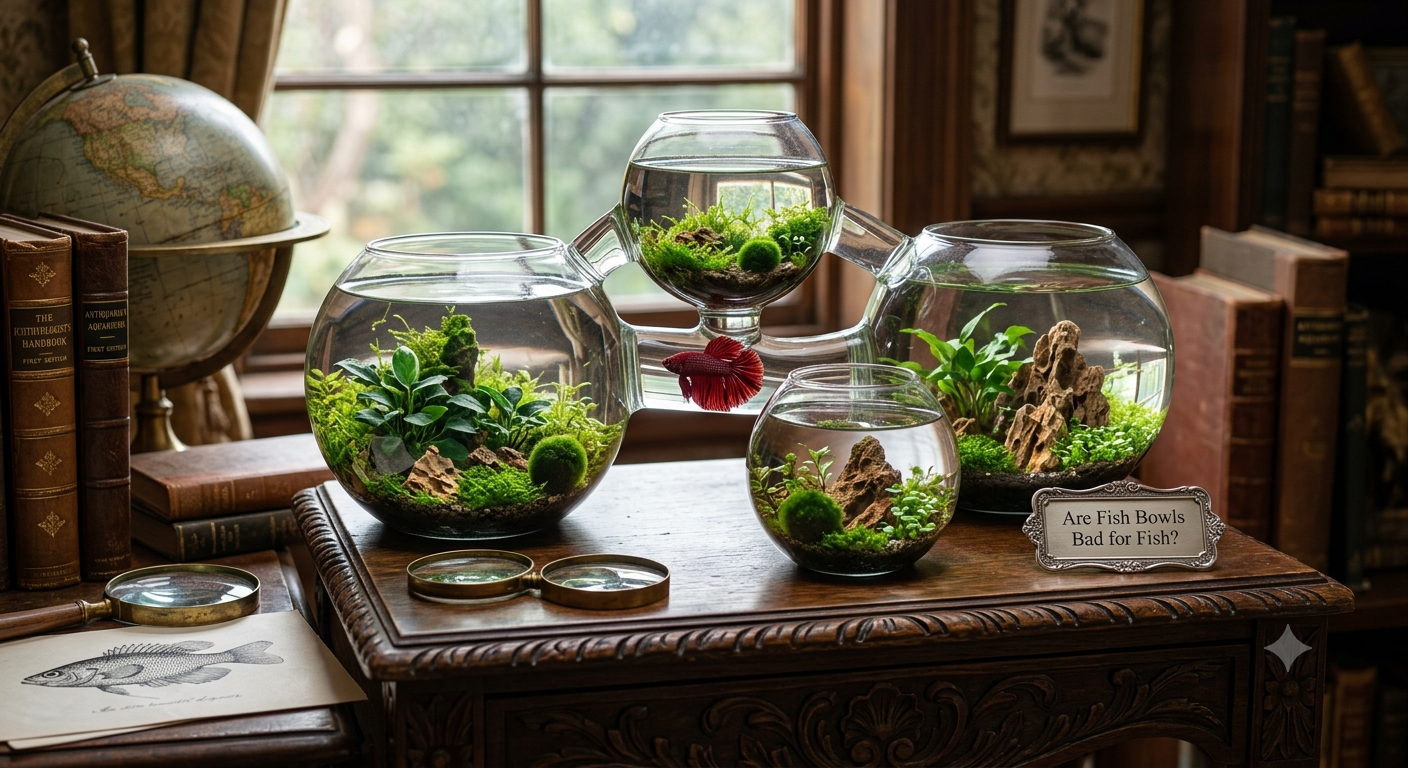
Are Fish Bowls Bad for Fish? (The Truth About Fish Bowls)
For generations, a small glass fish bowl has been one of the most recognizable symbols of keeping fish at home.
Many people remember seeing a goldfish swimming happily in a simple bowl on a child’s bedroom table, in a classroom, or at a pet store. Because this image has existed for so long, many beginners naturally assume that fish bowls are a normal and healthy way to keep aquarium fish.
But is that really true?
Are fish bowls bad for fish?
The honest answer is:
Most traditional fish bowls are not a good long-term environment for most fish.
The problem is not the glass container itself. A bowl can hold water, and fish can technically survive inside it. The real issue is that most fish bowls create unstable conditions that make it much harder to maintain healthy water quality.
Small water volume, limited oxygen exchange, rapid temperature changes, and the lack of filtration make fish bowls challenging even for experienced fish keepers.
This does not mean every person who has kept a fish bowl has intentionally harmed their fish. For many years, fish bowls were considered normal because people simply did not have access to the aquarium knowledge we have today.
Modern fish keeping has changed.
We now understand much more about:
- The nitrogen cycle
- Ammonia toxicity
- Oxygen requirements
- Fish behaviour
- Proper tank sizes
The goal of responsible fish keeping is not just keeping a fish alive.
The goal is creating an environment where the fish can stay healthy, behave naturally, and live a long life.
In this guide, we will look at why fish bowls became popular, why they often fail, whether any fish can live in a bowl, and what beginners should choose instead.
The Short Answer: Are Fish Bowls Bad for Fish?
Yes, most traditional fish bowls are bad for fish when used as a permanent home.
Fish bowls usually create several problems:
- Very limited water volume
- Faster ammonia buildup
- Poor oxygen exchange
- Unstable water temperature
- Little space for natural swimming behaviour
- Difficulty maintaining biological filtration
A fish may survive in a bowl for some time, but survival does not always mean the fish is healthy.
A properly maintained aquarium provides a much more stable environment because it offers:
- More swimming space
- Better filtration options
- More stable water conditions
- Improved oxygen circulation
For most common aquarium fish, a filtered aquarium is a much better choice than a bowl.
Why Do People Still Keep Fish in Bowls?
If fish bowls create so many challenges, why are they still so common?
The answer comes from history and convenience.
Fish bowls became popular because they are:
- Cheap
- Easy to buy
- Small enough for desks and shelves
- Simple to understand
- Visually attractive
A beginner walking into a pet store may see a small bowl, some colourful gravel, and a beautiful fish and assume:
“This must be everything the fish needs.”
Unfortunately, the reality is more complicated.
A bowl looks simple because it hides the complex biological processes happening inside.
Even the smallest fish tank is a living ecosystem.
Fish are constantly:
- Breathing
- Eating
- Producing waste
- Interacting with their environment
The water surrounding them needs to remain chemically stable.
A bowl makes maintaining that balance much harder.
The Biggest Problem With Fish Bowls: Small Water Volume
The biggest disadvantage of a fish bowl is its size.
Water volume plays a huge role in aquarium stability.
A larger aquarium gives you more room for mistakes.
For example, imagine dropping a small amount of waste into a swimming pool compared with dropping the same amount into a glass of water.
The waste exists in both situations, but the concentration is completely different.
The same principle applies to aquariums.
In a small bowl:
- A small amount of fish waste creates a large chemical change.
- Uneaten food breaks down quickly.
- Ammonia levels can rise rapidly.
- Water conditions fluctuate much faster.
This means fish living in bowls experience a much less stable environment.
A beginner might think:
“My fish only produces a tiny amount of waste.”
But inside a small bowl, even tiny amounts matter.
Fish Waste and the Ammonia Problem
One of the most important things beginners learn in fish keeping is that fish waste is dangerous.
Fish do not just create visible waste.
They also release ammonia through their gills and bodily waste.
Ammonia is extremely toxic to fish.
Even low levels can cause:
- Gill damage
- Stress
- Weak immune systems
- Difficulty breathing
- Increased risk of disease
In a healthy aquarium, beneficial bacteria convert ammonia into less harmful substances through the nitrogen cycle.
A filter provides a large surface area where these bacteria can live.
A fish bowl usually has:
- No filter
- Less surface area for bacteria
- Less oxygen movement
- Less biological stability
This means ammonia can accumulate much faster.
The water may still look clean, but invisible toxins may already be affecting the fish.
This is one of the biggest reasons experienced aquarists discourage traditional fish bowls.
Why Clean Water Does Not Always Mean Healthy Water
One of the most dangerous misconceptions in fish keeping is:
“If the water looks clean, the fish is healthy.”
Unfortunately, this is not true.
Many harmful aquarium problems cannot be seen.
Ammonia is invisible.
Nitrite is invisible.
Low oxygen is invisible.
A fish bowl can look beautiful while the water chemistry is slowly becoming dangerous.
This is why experienced fish keepers focus on:
- Testing water
- Maintaining filtration
- Monitoring fish behaviour
rather than simply looking at whether the water appears clear.
Oxygen Problems in Fish Bowls
One of the biggest challenges with fish bowls is maintaining enough oxygen for fish to breathe.
Many beginners assume that because a bowl is open at the top, the fish automatically has enough oxygen.
However, oxygen levels in water are not determined only by whether the container is open.
The amount of oxygen available depends on several factors:
- Water surface area
- Water movement
- Number of fish
- Water temperature
- Waste levels
In a normal aquarium, a filter helps create surface movement. This movement allows oxygen from the air to enter the water more efficiently.
A fish bowl usually has:
- No filter
- No water circulation
- No surface agitation
As a result, oxygen exchange happens much more slowly.
This becomes especially problematic when:
- The bowl is overcrowded
- The water becomes warm
- The fish is large
- The bowl is dirty
- The room has poor airflow
Fish need dissolved oxygen in the water, not just air above the water.
A bowl full of air above the water does not automatically mean the fish has enough oxygen.
Signs That a Fish Bowl Has Low Oxygen
Fish often show visible signs when oxygen levels are becoming too low.
Common warning signs include:
Fish Staying Near the Surface
When oxygen becomes limited, fish may swim near the surface because this area usually contains slightly more oxygen.
You may notice your fish repeatedly staying at the top of the bowl.
Rapid Gill Movement
Healthy fish breathe calmly.
If a fish’s gills are moving much faster than normal, it may be struggling to obtain enough oxygen.
Reduced Activity
Low oxygen can make fish appear tired or weak.
They may:
- Stop exploring
- Hide more often
- Sit at the bottom
- React slowly
Gasping at the Surface
This is a serious warning sign.
If your fish is repeatedly coming to the surface and appearing to gulp air, immediate action should be taken.
The water may need increased movement, better filtration, or a larger environment.
Temperature Changes Are More Dangerous in Fish Bowls
Another major problem with fish bowls is temperature instability.
Water temperature has a huge effect on fish health.
Most aquarium fish are not able to regulate their body temperature like mammals.
They depend on their environment.
A small amount of water changes temperature much faster than a larger aquarium.
For example:
A 5-litre bowl sitting near a window can heat up quickly during a sunny afternoon.
The same bowl can also become cold much faster at night.
These rapid temperature changes create stress.
Stress weakens the immune system and can make fish more vulnerable to:
- Disease
- Parasites
- Poor appetite
- Sudden death
A larger aquarium provides more thermal stability because more water takes longer to heat up or cool down.
This is one reason experienced fish keepers usually recommend larger tanks for beginners.
A bigger aquarium is actually easier to maintain than a tiny bowl.
That may sound surprising, but stability is the key.
Why Goldfish Bowls Are One of the Biggest Fish Keeping Myths
When most people think about fish bowls, they imagine one fish:
The goldfish.
The classic image of a goldfish swimming in a small glass bowl has existed for generations.
Unfortunately, this is one of the most misleading ideas in fish keeping.
Goldfish are often considered “easy beginner fish,” but they are actually demanding animals with specific needs.
They produce a large amount of waste compared with many other aquarium fish.
This creates several problems in a small bowl:
- Ammonia builds up quickly
- Water becomes polluted faster
- Oxygen levels drop more easily
- The fish experiences chronic stress
A goldfish may survive in a bowl, but survival is very different from thriving.
A healthy goldfish should have:
- Adequate swimming space
- Strong filtration
- Good oxygenation
- Stable water parameters
Many goldfish also grow much larger than beginners expect.
A small goldfish purchased from a pet store may eventually become a large fish requiring a much bigger aquarium.
Can Goldfish Live in a Bowl Without a Filter?
Technically, a goldfish can survive in a bowl for some time.
However, this does not mean it is a suitable environment.
Without a filter:
- Waste accumulates quickly
- Beneficial bacteria have limited space
- Oxygen levels become unstable
- Water changes become frequent
Some people maintain goldfish temporarily without filters using very frequent water changes and careful monitoring.
However, this requires much more effort than maintaining a properly filtered aquarium.
For most fish owners, especially beginners, a filtered tank is the healthier and easier choice.
Can Betta Fish Live in a Bowl?
Betta fish are another species commonly kept in bowls.
This happens because bettas have a special ability.
They possess a labyrinth organ, which allows them to breathe atmospheric air from the water surface.
Because of this ability, many people believe:
“Betta fish don’t need filters.”
This is a misunderstanding.
A betta’s ability to breathe air helps it survive in environments with lower oxygen levels.
However, it does not protect the fish from poor water quality.
A betta living in a dirty bowl can still suffer from:
- Ammonia poisoning
- Stress
- Fin damage
- Disease
A betta fish can survive in a bowl, but a properly sized filtered aquarium provides a much better environment.
A healthy betta setup usually includes:
- A suitable tank size
- Gentle filtration
- Stable temperature
- Regular maintenance
Why Small Bowls Are Difficult Even for Experienced Fish Keepers
Some experienced aquarium owners do maintain small containers without filters.
However, there is a major difference between an experienced aquarist and a beginner.
An experienced fish keeper understands:
- Water chemistry
- Fish behaviour
- Biological filtration
- Maintenance schedules
- Testing parameters
They know how to react when something changes.
A beginner may not notice problems until the fish is already suffering.
This is why advice online can sometimes seem confusing.
One person may say:
“My fish lived in a bowl for years.”
Another person may say:
“Never keep fish in bowls.”
Both statements can exist because they are talking about different levels of experience and care.
The question is not only:
“Can a fish survive in a bowl?”
The better question is:
“Can I consistently provide the stable conditions this fish needs?”
For most beginners, the answer is easier with an aquarium.
Can Fish Live in a Bowl Without a Filter?
This is one of the most searched questions related to fish bowls.
The honest answer:
Yes, some fish can survive temporarily without a filter, but it requires careful maintenance and is not ideal for most species.
A filter provides several important benefits:
Biological Filtration
Beneficial bacteria need a place to grow.
A filter provides a large surface area for these bacteria.
They help process harmful ammonia and nitrite.
Mechanical Filtration
Filters remove:
- Uneaten food
- Plant debris
- Waste particles
Without filtration, these materials remain inside the water longer.
Water Movement
Filters create circulation.
This helps:
- Distribute oxygen
- Prevent stagnant areas
- Keep water conditions more consistent
Without a filter, the fish owner must manually replace many of these functions.
This usually means:
- More frequent water testing
- More frequent water changes
- Greater attention to feeding amounts
For beginners, a filtered aquarium is usually much more forgiving.
Fish Bowl vs Aquarium: What Is the Difference?
The difference between a fish bowl and an aquarium is not just appearance.
The main difference is stability.
| Fish Bowl | Aquarium |
|---|---|
| Small water volume | Larger water volume |
| Difficult temperature control | More stable temperature |
| Usually no filtration | Can use filters |
| Limited swimming space | More natural environment |
| Faster waste buildup | Better waste management |
| Less oxygen movement | Better oxygen exchange |
A properly maintained aquarium gives fish a much higher chance of living a healthy life.
Are Any Fish Suitable for a Fish Bowl?
After learning about the challenges of fish bowls, many people ask:
“Does this mean no fish can ever live in a bowl?”
The answer requires some balance.
A small bowl is not automatically harmful simply because it is a bowl. The problem is that most bowls are too small and lack the equipment needed to maintain stable conditions.
Some experienced fish keepers may use small containers for specific purposes, such as:
- Temporary holding
- Quarantine situations
- Breeding projects
- Aquatic plants
- Certain very small aquatic animals
However, for most common pet fish, a traditional decorative bowl is not the best permanent home.
The issue is not about judging the container itself.
The issue is whether the environment can consistently provide:
- Clean water
- Enough oxygen
- Stable temperature
- Enough swimming space
- Appropriate care
If those needs cannot be met, the fish will eventually suffer.
Why Shrimp and Snails Are Sometimes Better Choices Than Fish
Although traditional fish bowls are not ideal for most fish, some small aquatic setups can work better with different animals.
For example, some people successfully keep:
- Certain freshwater shrimp
- Small snails
- Aquatic plants
in carefully maintained nano containers.
However, even these setups still require knowledge and maintenance.
A planted jar or bowl is not automatically maintenance-free.
It still requires understanding:
- Light requirements
- Plant growth
- Water balance
- Nutrient levels
The important lesson is that every aquatic animal has different needs.
A setup that works for a shrimp colony may not be suitable for a fish.
Better Alternatives to Fish Bowls
If you like the appearance of a fish bowl but want a healthier environment for your fish, there are much better options available.
Small Aquarium Tanks
A small aquarium is usually the easiest upgrade from a bowl.
Even a modest aquarium provides:
- More water volume
- Better swimming space
- Space for a filter
- More stable conditions
Many beginner-friendly aquarium kits include:
- Tank
- Filter
- Light
- Lid
This makes starting a proper aquarium much easier.
Nano Aquariums
Nano aquariums have become very popular because they provide the beauty of a small setup while offering better stability.
Compared with a traditional bowl, a nano aquarium gives you more control over:
- Filtration
- Temperature
- Water quality
They are ideal for people who have limited space but still want a healthy aquatic environment.
Larger Beginner Tanks
Interestingly, a larger aquarium is often easier for beginners.
Many people assume:
“Small tank = easier.”
In reality, the opposite is often true.
A small amount of water changes quickly.
A larger aquarium gives you more time to correct mistakes.
For example:
- Overfeeding in a small bowl can create an ammonia spike quickly.
- The same mistake in a larger aquarium may have a much smaller effect.
This extra stability makes larger tanks more beginner-friendly.
What Size Aquarium Should a Beginner Choose Instead?
There is no single perfect tank size for everyone.
However, many experienced fish keepers recommend starting with something around:
- 40 litres (10 gallons) or larger for beginners
A tank of this size provides enough room for:
- A reliable filter
- Stable water conditions
- Easier maintenance
- More fish choices
Of course, the correct size depends on the species.
A single betta fish has different requirements from goldfish or a community aquarium.
Researching the needs of the specific fish before buying is always the best approach.
How to Move a Fish From a Bowl to an Aquarium
If you currently have a fish living in a bowl, moving it to a proper aquarium can greatly improve its quality of life.
However, the transition should be done carefully.
Step 1: Prepare the New Aquarium
Before moving the fish:
- Set up the aquarium
- Add conditioned water
- Install the filter
- Match the temperature
- Allow equipment to run properly
The aquarium should be ready before introducing the fish.
Step 2: Avoid Sudden Temperature Changes
Fish are sensitive to rapid environmental changes.
A sudden temperature difference can cause unnecessary stress.
Allow the fish to slowly adjust to the new water conditions.
Step 3: Monitor Water Quality
After moving the fish, monitor:
- Ammonia
- Nitrite
- Nitrate
- pH
A new aquarium may experience changes while beneficial bacteria establish themselves.
This process is known as cycling.
Understanding the nitrogen cycle is one of the most important parts of successful fish keeping.
Why People Should Not Feel Guilty About Using Fish Bowls
It is important to discuss this topic respectfully.
Many people have used fish bowls because they were following information that was commonly accepted for many years.
Fish keeping knowledge has changed.
Today, we understand much more about:
- Fish behaviour
- Water chemistry
- Animal welfare
- Aquarium biology
The goal is not to criticize people who previously used bowls.
The goal is to provide better information so future fish keepers can make healthier choices.
Improving fish care starts with education.
Common Fish Bowl Mistakes Beginners Make
Many problems with fish bowls come from a few common mistakes.
Overfeeding
This is one of the biggest issues.
People often think:
“My fish looks hungry, so I should give more food.”
However, uneaten food quickly breaks down and increases waste.
A small bowl has very little ability to handle extra waste.
Keeping Too Many Fish Together
A bowl may look large enough for multiple fish, but the available water volume is usually very limited.
More fish means:
- More waste
- More oxygen consumption
- More competition for space
Overcrowding creates stress and poor water quality.
Not Testing the Water
Many bowl owners never test water because they assume the small setup is simple.
However, small containers often require more attention, not less.
Testing helps identify invisible problems before fish become sick.
Cleaning Too Frequently
Another common mistake is completely replacing all water every few days.
While water changes are important, replacing everything can create sudden changes in:
- Temperature
- pH
- Water chemistry
A stable environment is usually healthier than a constantly changing one.
Frequently Asked Questions About Fish Bowls
Are fish bowls cruel?
A fish bowl itself is not automatically cruel.
The problem is that many traditional bowls do not provide the stable environment most fish need.
A fish kept in poor water conditions, with insufficient space and no proper filtration, may experience stress and health problems.
Choosing an appropriate habitat based on the fish’s needs is the most important factor.
Can fish live in a bowl?
Yes, some fish may survive in a bowl temporarily.
However, most common aquarium fish will be healthier in a properly maintained aquarium with appropriate filtration and space.
Survival does not always mean the fish is living in ideal conditions.
Can fish live in a fish bowl without a filter?
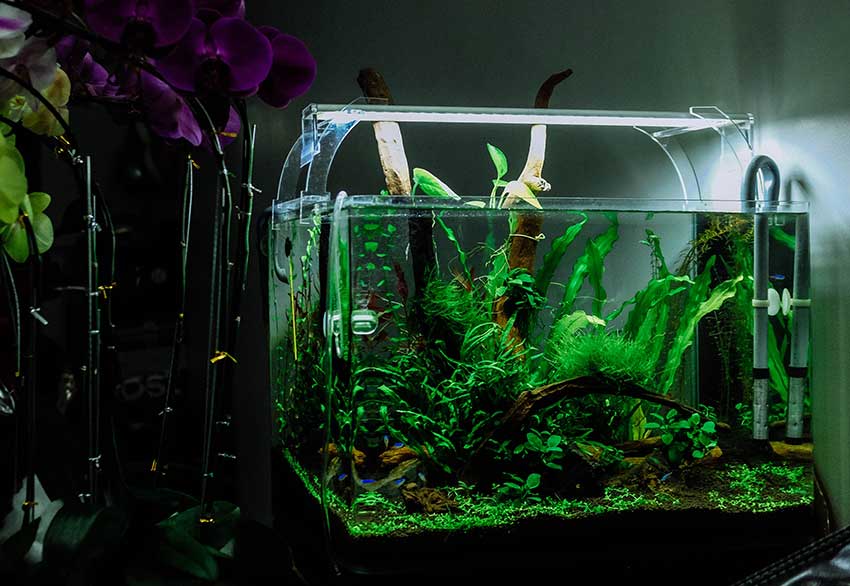
Some fish can survive without a filter if the owner provides very careful maintenance.
However, maintaining good water quality becomes much more difficult.
For most beginners, using a filter is strongly recommended.
Why are fish bowls bad?
Fish bowls are often problematic because they:
- Hold limited water volume
- Allow waste to build up quickly
- Have poor oxygen circulation
- Experience temperature changes
- Provide limited swimming space
These factors make long-term fish care more challenging.
Can betta fish live in a bowl?
Betta fish can survive in bowls because they can breathe atmospheric air.
However, they still need clean water, stable temperature, and enough space.
A filtered aquarium is usually a much healthier choice for bettas.
Can goldfish live in a bowl?
Goldfish are not recommended for bowls.
They produce a large amount of waste and require more space and filtration than most people expect.
A proper aquarium or pond setup is much more suitable.
Final Verdict: Are Fish Bowls Bad for Fish?
So, what is the honest answer?
Most traditional fish bowls are not suitable as permanent homes for aquarium fish.
Although fish may survive in bowls, they often face challenges that are much easier to manage in a proper aquarium.
The biggest problems are:
- Poor water stability
- Limited oxygen exchange
- Rapid waste buildup
- Lack of filtration
- Restricted swimming space
A healthy aquarium does not need to be expensive or complicated.
Even a small filtered tank can provide a much better environment than a decorative bowl.
The most important thing in fish keeping is understanding that fish are living animals with specific needs.
A beautiful container is not enough.
The goal should always be to create an environment where fish can:
- Swim naturally
- Breathe comfortably
- Stay healthy
- Live a long life
If you are thinking about keeping fish for the first time, choosing a proper aquarium instead of a bowl is one of the best decisions you can make.
Your fish will be healthier, maintenance will usually become easier, and you will enjoy the hobby much more.
)