Can Fish Live Without a Filter? The Honest Answer
Can Fish Live Without a Filter? (Honest Answer)
Have you ever looked at your aquarium after the filter suddenly stopped and wondered, “Will my fish be okay?” Maybe the power went out overnight, your filter motor failed without warning, or you’re setting up your very first tank and trying to decide whether you really need a filter at all.
You’re certainly not alone. Every month, thousands of aquarium owners search online asking the same question: Can fish live without a filter?
The short answer is yes—but only under certain conditions, and usually not for very long.
This is where many beginners become confused. People often hear stories about betta fish living in bowls, goldfish surviving in jars at fairs, or someone claiming they’ve kept fish for years without using a filter. While these stories may contain a small amount of truth, they rarely tell the whole story.
The reality is that surviving and living a healthy life are two completely different things.
A fish might survive in poor water conditions for weeks or even months, but that doesn’t mean it’s comfortable, healthy, or able to live its full lifespan. Many fish silently suffer from stress, poor water quality, and ammonia poisoning long before they show visible signs that something is wrong.
Understanding this difference is one of the biggest steps toward becoming a successful fish keeper.
In this guide, we’ll explore exactly what happens when an aquarium has no filter, how long fish can realistically survive, which species are more tolerant than others, and what you should do if your filter suddenly stops working. Whether you own a betta, goldfish, guppies, tetras, or a community aquarium, you’ll leave with a much clearer understanding of what your fish actually need.
By the end of this article, you’ll also understand why so many experienced aquarists consider the filter to be the heart of an aquarium—not because it keeps the water looking clean, but because it keeps the entire ecosystem alive.
The Short Answer
Can fish live without a filter?
Yes, fish can survive without a filter for a limited period, but most aquarium fish cannot live healthy, long-term lives without one. A filter removes waste, supports beneficial bacteria, improves water circulation, and helps maintain stable water conditions. Without filtration, toxic ammonia can build up quickly, oxygen levels may decrease, and fish become far more vulnerable to stress and disease.
Some hardy species, such as betta fish, may tolerate filterless conditions better than others, but even they benefit from filtered, stable water. A filterless aquarium is possible only under carefully controlled conditions and usually requires much more maintenance than a filtered tank.
If you’re reading this because your filter has suddenly stopped working, don’t panic. Most fish can survive for several hours—and often longer—provided you take the right emergency steps. We’ll cover those later in this guide.
Why This Question Is More Complicated Than You Think
One of the biggest reasons beginners get confused is because there isn’t a single answer that applies to every aquarium.
Imagine asking someone, “Can people live without air conditioning?”
If you live in northern Canada, the answer might be yes.
If you live in the middle of the Australian summer, the answer becomes much more complicated.
Aquariums work in a similar way.
Whether fish can live without a filter depends on many different factors, including:
- The size of the aquarium
- The number of fish inside it
- The species you’re keeping
- Whether live plants are present
- Water temperature
- Feeding habits
- Maintenance routine
- Whether the tank has already established beneficial bacteria
A lightly stocked, heavily planted 40-gallon aquarium behaves very differently from a five-gallon bowl containing three goldfish.
That’s why you’ll often find completely opposite answers online.
Someone with years of experience maintaining natural planted aquariums may genuinely keep fish without a filter. Meanwhile, another beginner may lose fish within days after switching their filter off.
Both experiences can be true because the aquariums themselves are completely different.
Throughout this guide, we’ll explain why these differences matter instead of simply saying “yes” or “no.”
My First Lesson About Aquarium Filters
When I bought my first aquarium years ago, I made the same mistake that many beginners make.
I thought the filter’s only purpose was to remove dirt from the water.
As long as the water looked crystal clear, I assumed everything inside the tank was healthy.
Then one weekend my filter stopped working while I was away from home.
When I came back, something looked strange. The water still appeared perfectly clean, but several fish were swimming near the surface, opening and closing their mouths much faster than usual.
Nothing looked dirty.
Nothing smelled unusual.
Yet something was clearly wrong.
After testing the water, I discovered that ammonia had begun rising even though the tank looked spotless.
That experience taught me one of the most important lessons in fishkeeping:
Clear water does not always mean safe water.
The greatest dangers inside an aquarium are usually invisible.
Today, whenever someone asks whether fish really need a filter, I remember that experience because it’s exactly where many beginners start.
What Does a Fish Tank Filter Actually Do?
If someone asked ten beginners what a filter does, most would probably answer:
“It cleans the water.”
While that isn’t completely wrong, it’s only a small part of the story.
A modern aquarium filter actually performs several jobs at the same time, each of which helps create a stable environment for fish.
Understanding these jobs makes it much easier to understand why filters are so valuable.
Mechanical Filtration
This is the part most people notice first.
As water passes through the filter, pieces of sponge or filter floss trap physical waste such as fish poop, leftover food, dead plant leaves, and floating debris.
Without this process, particles remain suspended in the water, making the aquarium look cloudy over time.
Mechanical filtration keeps the tank looking cleaner, but surprisingly, it isn’t the most important function of the filter.
Biological Filtration
If mechanical filtration keeps the aquarium looking clean, biological filtration is what actually keeps fish alive.
Every fish constantly releases waste into the water.
That waste produces ammonia, which is highly toxic.
Even small amounts of ammonia can burn fish gills, damage internal organs, weaken the immune system, and eventually cause death.
Fortunately, nature provides a solution.
Inside every healthy aquarium live billions of beneficial bacteria.
These bacteria convert harmful ammonia into nitrite.
Different bacteria then convert nitrite into nitrate, which is much less harmful and can be removed through regular water changes or absorbed by plants.
This entire process is known as the nitrogen cycle.
Your filter provides an enormous surface area where these bacteria can live safely.
In many ways, the filter isn’t simply cleaning the water.
It’s housing an invisible army of microorganisms that protect your fish every minute of every day.
Chemical Filtration
Some filters also contain activated carbon or other specialized media.
These materials remove:
- Medication residues
- Water discoloration
- Odours
- Certain dissolved chemicals
Chemical filtration is useful in some situations but isn’t essential for most freshwater aquariums.
Mechanical and biological filtration remain far more important.
The Nitrogen Cycle Explained in Simple English
If you’ve spent any time reading aquarium advice, you’ve probably seen the phrase “cycle your tank.”
For beginners, it often sounds complicated.
Fortunately, the basic idea is actually quite simple.
Imagine forgetting to take the rubbish out of your kitchen for several weeks.
Eventually it would begin producing unpleasant gases.
The same thing happens inside an aquarium.
Fish produce waste.
Leftover food breaks down.
Dead plant material decomposes.
All of this creates ammonia.
Without beneficial bacteria, ammonia continues building until it becomes poisonous.
The nitrogen cycle is simply nature’s cleaning system.
Beneficial bacteria eat ammonia.
Different bacteria then process the waste again.
Eventually it becomes nitrate, which is much safer and removed during water changes.
A filter acts like a giant apartment building for these bacteria.
Remove the filter—or allow it to stop working for long enough—and the bacterial colony begins losing oxygen and can eventually die back.
That’s why experienced aquarists become concerned when a filter stops running.
They’re not only thinking about water movement.
They’re thinking about protecting the bacteria that keep the entire aquarium stable.
Can Fish Really Live Without a Filter?
Now that you understand what a filter actually does, we can answer the main question more honestly.
Yes, fish can live without a filter.
But that statement needs an important explanation.
Fish can survive without a filter under certain conditions because filters themselves don’t magically keep fish alive.
Instead, they provide the conditions that make healthy water easier to maintain.
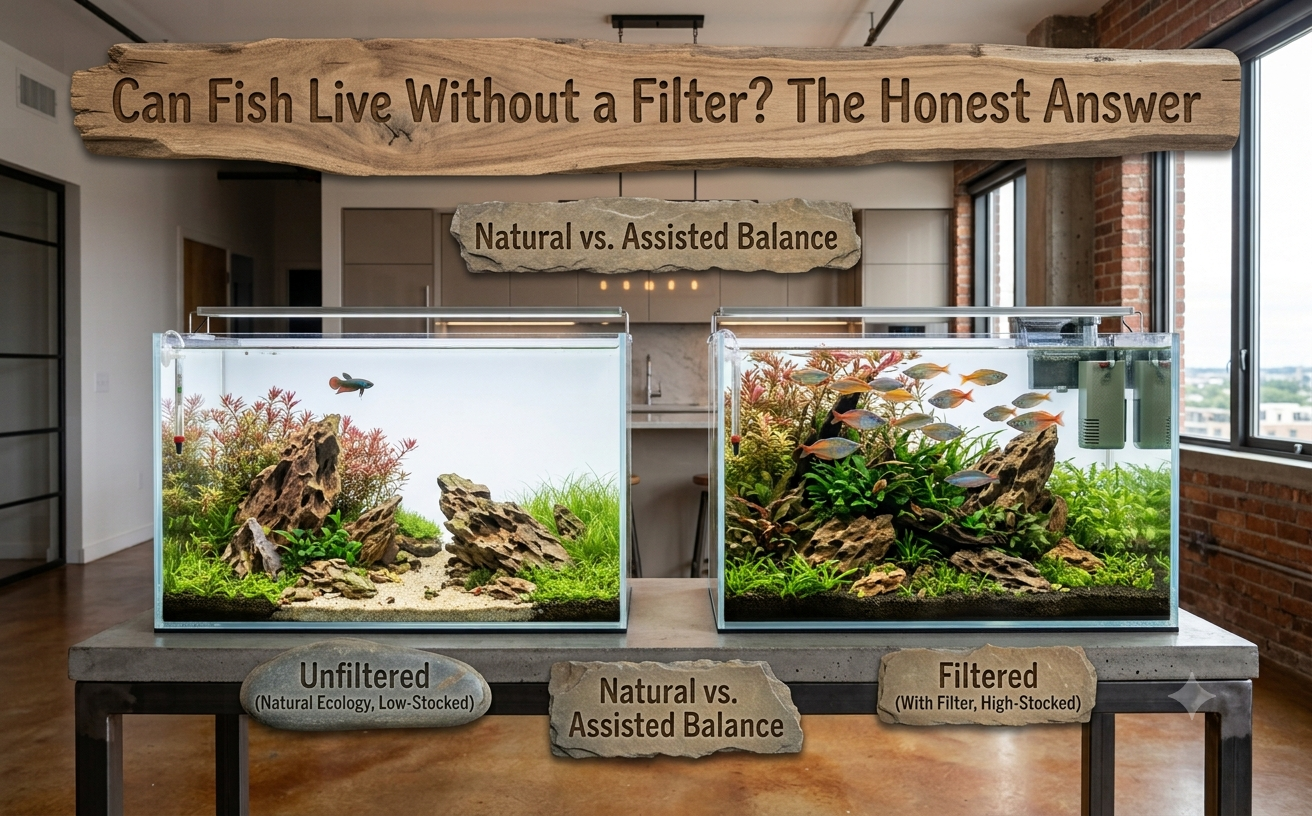
If you can maintain those same conditions through other methods—such as heavily planted aquariums, extremely light stocking, and frequent water changes—then technically a filter isn’t always essential.
This is why experienced aquascapers sometimes run beautiful natural aquariums without conventional filtration.
However, these setups require knowledge, patience, and careful observation.
For the average beginner, removing the filter usually means removing the single biggest safety net in the aquarium.
That’s why nearly every experienced fish keeper recommends using one.
Not because fish instantly die without it, but because it makes maintaining stable, healthy water dramatically easier.
Can Fish Live Without a Filter in a Tank?
Now that we understand the role of a filter, the next question is more specific:
Can fish live without a filter in a tank?
The answer is yes, but the conditions matter more than most people realize.
A fish tank without a filter is not automatically impossible. In fact, some experienced aquarium keepers intentionally create filterless aquariums using natural methods. These setups usually rely on heavy planting, low fish numbers, mature biological systems, and very careful maintenance.
However, the average beginner aquarium is usually not designed for this.
When most people set up a new aquarium, they typically have:
- A few fish in a relatively small tank
- Artificial decorations instead of many live plants
- Limited knowledge of water chemistry
- Irregular water testing
- Normal feeding schedules
In this situation, removing the filter can quickly create problems.
The biggest issue is not that fish suddenly lose their “clean water.” The biggest issue is that waste products begin accumulating faster than the aquarium ecosystem can process them.
A healthy aquarium is a balance between:
- Fish waste production
- Beneficial bacteria
- Water volume
- Oxygen availability
- Maintenance
A filter helps maintain that balance.
Without one, the responsibility shifts entirely to the fish keeper.
What Happens When a Fish Tank Has No Filter?
When a filter is removed, several changes begin happening inside the aquarium.
Some changes happen immediately, while others take days or weeks to become noticeable.
Waste Begins Building Up
Fish are constantly producing waste.
Even if your fish look healthy and active, they are releasing ammonia into the water every day.
In a filtered aquarium, beneficial bacteria process this waste continuously.
In a tank without filtration, the waste has fewer places to go.
Eventually, ammonia and nitrite can increase.
The dangerous part is that these substances are invisible.
The water may look:
- Crystal clear
- Odour-free
- Completely normal
But the chemical conditions may already be harmful.
This is why many beginner fish keepers are shocked when fish become sick in “clean-looking” water.
Oxygen Levels Can Decrease
A filter also creates water movement.
This movement helps oxygen from the air enter the aquarium.
Without movement, the water surface becomes still, and oxygen exchange becomes slower.
This is especially risky when:
- The tank is small
- The water temperature is high
- There are many fish
- The aquarium is covered with a tight lid
Fish need dissolved oxygen in the water to breathe through their gills.
When oxygen levels become low, fish may start:
- Swimming near the surface
- Breathing rapidly
- Staying close to areas where water moves
These are warning signs that should never be ignored.
The Aquarium Becomes Less Stable
One of the biggest benefits of a filter is stability.
A mature aquarium is like a small ecosystem. Changes happen slowly, giving fish time to adapt.
Without a filter, conditions can change much faster.
A small mistake such as:
- Overfeeding
- Adding too many fish
- Missing a water change
can create serious problems.
This is why filters are often described as a “safety net” for aquarium owners.
How Long Can Fish Live Without a Filter?
This is probably the most searched question related to this topic.
How long can fish live without a filter?
Unfortunately, there is no exact number that applies to every aquarium.
Some fish may survive several days, while others may struggle within hours.
The survival time depends on many factors.
Tank Size
A larger aquarium usually provides more stability.
For example, a 75-gallon aquarium with a few small fish contains much more water volume than a 5-gallon tank.
Waste becomes diluted more slowly in larger tanks.
Small aquariums can experience dangerous changes much faster.
Number of Fish
Stocking levels are extremely important.
A lightly stocked aquarium produces less waste and consumes less oxygen.
An overcrowded aquarium can become dangerous very quickly.
This is why a filterless aquarium with two small fish may be manageable, while a crowded aquarium with ten fish may fail quickly.
Fish Species
Different fish have different levels of tolerance.
Some hardy species can handle poor conditions temporarily.
Others are extremely sensitive to changes in water quality.
For example:
- Betta fish tolerate low oxygen better than many species
- Goldfish create large amounts of waste
- Many tropical fish require stable water conditions
Feeding Amount
Food directly affects water quality.
Many beginners make this mistake:
“My filter stopped, so I should feed my fish to keep them strong.”
The opposite is usually true.
Less food means:
- Less waste
- Less ammonia
- More time before water quality becomes dangerous
Healthy adult fish can usually go several days without food.
General Time Estimate
While every aquarium is different, a realistic guideline is:
A few hours without filtration
Usually not a problem.
Around 24 hours
Most healthy tanks can handle this.
2–3 days
Water quality may begin declining, especially in smaller tanks.
Several days or longer
Risk increases significantly.
The important thing is not waiting until fish show problems.
By the time fish are visibly stressed, water conditions may already be poor.
Can Fish Live Without a Filter in a Bowl?
This is one of the most controversial topics in fishkeeping.
Many people have seen fish kept in small bowls and assume this means bowls are suitable.
Unfortunately, the reality is very different.
A fish bowl is one of the most challenging environments for a fish because it provides very little room for error.
Why Fish Bowls Are Problematic
A typical fish bowl has:
- Very little water volume
- Limited oxygen exchange
- No biological filtration
- Unstable temperature
In a larger aquarium, mistakes are diluted.
In a bowl, even a small amount of waste can create major water quality problems.
Imagine adding a teaspoon of salt into a swimming pool versus adding it into a glass of water.
The same amount has a completely different effect.
Aquariums work the same way.
Can Fish Live Without a Filter in a Bowl?
Technically, yes, some fish can survive for a period of time.
But survival does not mean the environment is healthy.
Without a filter:
- Waste accumulates quickly
- Ammonia rises faster
- Oxygen levels fluctuate
- Water temperature changes rapidly
This creates constant stress.
A stressed fish may:
- Become less active
- Lose colour
- Stop eating
- Become vulnerable to disease
Goldfish Bowls: One of the Biggest Myths
Goldfish are probably the most misunderstood aquarium fish.
Many people believe goldfish are suitable for bowls because they are often sold that way.
However, goldfish:
- Grow much larger than expected
- Produce significant waste
- Require high oxygen levels
- Need proper filtration
A goldfish bowl may look simple, but it creates a difficult environment for the fish.
Betta Fish Bowls
Betta fish are another species commonly kept without filters.
Bettas are special because they have a labyrinth organ that allows them to breathe atmospheric air.
This means they can survive in lower oxygen conditions compared with many other fish.
However, this does not mean they do not need clean water.
A betta still produces waste.
A betta still experiences ammonia exposure.
A betta still benefits from filtration.
A properly filtered betta aquarium allows the fish to:
- Display natural behaviour
- Swim comfortably
- Maintain better health
Which Fish Can Survive Without a Filter?
Some fish are more tolerant of temporary filterless conditions than others.
However, there is a big difference between “can survive” and “should be kept this way.”
Betta Fish
Betta fish are among the most commonly mentioned filterless fish.
Their ability to breathe air helps them tolerate lower oxygen levels.
However, they still require:
- Clean water
- Stable temperature
- Low ammonia
A filter is still recommended.
Guppies
Guppies are hardy and adaptable.
They can handle small changes better than many sensitive species.
However, they still produce waste and need good water quality.
Goldfish
Goldfish are often considered hardy, but this can be misleading.
They may survive poor conditions, but they are heavy waste producers.
They actually require strong filtration more than many beginner fish.
Shrimp
Shrimp produce very little waste and are sometimes kept in low-tech planted tanks.
However, they are sensitive to sudden changes.
Stable water conditions are extremely important.
Filter Failure vs Permanent Filterless Tanks
There is an important difference between these two situations.
A filter failure is an emergency.
A permanent filterless aquarium is a deliberate setup.
If your filter breaks, your goal is simply to protect your fish until normal filtration returns.
If you intentionally create a filterless aquarium, you need to design the entire system differently.
Experienced hobbyists may use:
- Heavy planting
- Large water volume
- Low stocking
- Regular testing
- Careful feeding
But this requires knowledge.
For most aquarium owners, keeping a reliable filter is the easier and safer option.
What To Do If Your Aquarium Filter Suddenly Stops Working
Even if you understand that filters are important, accidents happen. Filters stop working because of power failures, motor problems, clogged parts, or simple wear and tear.
The good news is that a broken filter does not automatically mean your fish are going to die.
Many fish can survive a temporary filter failure if the right steps are taken quickly.
The biggest mistake beginners make is panicking and making too many changes at once. Sudden temperature changes, moving fish unnecessarily, or completely replacing tank water can sometimes create even more stress.
The goal is simple:
Keep oxygen available, reduce waste production, and restore filtration as soon as possible.
Stop Feeding Your Fish
The first thing you should do when your filter stops is reduce or completely stop feeding.
This may feel wrong, especially when your fish are already in a stressful situation. However, feeding creates more waste, and waste creates ammonia.
Healthy adult fish can usually go several days without food.
A short fasting period will not harm them, but extra waste during a filter failure can quickly make the situation worse.
Increase Surface Movement
Since oxygen enters the aquarium mainly through the water surface, creating movement can help.
If your filter is not running, you can temporarily increase oxygen exchange by:
- Gently moving the water surface with a clean container
- Pouring aquarium water back into the tank from a small height
- Using a battery-powered air pump if available
The purpose is not to create bubbles. The purpose is to increase gas exchange.
Check Whether the Filter Can Be Fixed
Before assuming the filter is completely broken, check a few simple things.
Many filter problems are caused by:
- A clogged sponge
- Debris blocking the impeller
- An air lock
- Incorrect water level
- Power connection issues
Sometimes a filter that appears dead can be working again within a few minutes after cleaning or resetting it.
Perform Partial Water Changes Carefully
If the filter will not be fixed quickly, partial water changes can help reduce harmful substances.
A good approach is usually:
- Replace around 20–30% of the water
- Use water treated with a dechlorinator
- Match the temperature as closely as possible
Avoid completely replacing all aquarium water unless there is an extreme emergency.
Your aquarium contains beneficial bacteria on surfaces, decorations, gravel, and filter media. Removing everything can destroy much of the biological balance.
How To Keep Fish Alive Without a Filter Temporarily
If you are waiting for a replacement filter or dealing with an emergency, these steps can improve your fish’s chances.
Reduce Stress
Stress makes fish weaker and more vulnerable to disease.
During a filter problem:
- Keep aquarium lights reduced
- Avoid moving decorations
- Do not catch or handle fish unnecessarily
- Avoid adding new fish
A calm environment helps fish conserve energy.
Monitor Fish Behaviour
Your fish will often tell you when something is wrong.
Pay attention to:
- Gasping near the surface
- Fast gill movement
- Unusual hiding
- Loss of appetite
- Swimming near water movement
These behaviours are warning signs that water conditions may be deteriorating.
Test Water Parameters
If you have aquarium test kits, this is the best time to use them.
Important parameters include:
- Ammonia
- Nitrite
- Nitrate
- pH
Remember, the most dangerous problems are often invisible.
A water test can reveal issues before fish show serious symptoms.
Common Myths About Filterless Aquariums
There are many myths online about fish living without filters. Some contain a small amount of truth but miss important details.
Let’s clear up some of the most common ones.
Myth 1: “Fish Don’t Need Filters Because They Live in Nature”
This is probably the most common argument.
People often say:
“Fish live in rivers and lakes without filters, so why do aquarium fish need them?”
The difference is the size and complexity of natural environments.
A lake may contain millions of litres of water. It has:
- Plants
- Microorganisms
- Natural water movement
- Constant environmental changes
A small home aquarium is a closed system.
Waste produced by one fish in a small tank does not disappear. It remains inside the same limited amount of water.
A filter helps recreate some of the natural processes that happen in larger ecosystems.
Myth 2: “If the Water Looks Clean, the Fish Are Healthy”
Clear water is one of the biggest traps for beginner fish keepers.
A tank can look beautiful while containing dangerous levels of ammonia or nitrite.
Many harmful substances:
- Have no colour
- Have no smell
- Cannot be seen
This is why experienced fish keepers focus on water quality, not only appearance.
A sparkling clear aquarium is not automatically a healthy aquarium.
Myth 3: “Bettas Don’t Need Filters”
Because bettas can breathe atmospheric air, many people believe they do not require filtration.
This is incorrect.
A betta’s ability to breathe air helps it survive low oxygen environments, but it does not protect it from:
- Ammonia
- Poor water quality
- Dirty water
A filtered betta aquarium is usually healthier and easier to maintain.
Myth 4: “More Frequent Water Changes Replace a Filter”
Regular water changes are extremely important, but they are not exactly the same as filtration.
Water changes remove some waste, but they do not provide:
- Continuous biological filtration
- Constant water movement
- A stable bacterial colony
In a filterless aquarium, the owner must take over many jobs that a filter normally handles.
Frequently Asked Questions
Can fish survive overnight without a filter?
Yes, most healthy fish can survive overnight without a filter, especially if the aquarium is properly maintained and not overcrowded.
A short filter interruption is usually not dangerous.
However, if the filter remains off for several days, water quality problems can develop.
How long can fish live without a filter?
There is no exact time because every aquarium is different.
Some fish may survive several days, while others may experience problems much sooner.
The biggest factors are:
- Tank size
- Number of fish
- Temperature
- Feeding amount
- Water movement
A lightly stocked large aquarium may last longer than a small crowded tank.
Can fish live without a filter in a tank?
Yes, but it requires careful management.
A filterless aquarium usually needs:
- Low stocking
- Frequent maintenance
- Stable conditions
- Good understanding of aquarium biology
For most beginners, using a filter is strongly recommended.
Can fish live without a filter in a bowl?
Some fish may survive temporarily, but bowls are generally not recommended.
Small bowls create unstable conditions because:
- Waste builds up quickly
- Oxygen changes rapidly
- Temperature fluctuates easily
A properly sized aquarium is much healthier for fish.
How long can fish live without air pump or filter?
Fish can often survive short periods without an air pump or filter.
However, survival depends on oxygen availability and water quality.
A tank with no filter and no air movement becomes risky much faster than a tank with good circulation.
Do all aquariums need an air pump?
No.
Many aquariums do not require a separate air pump because their filter already creates enough surface movement.
Air pumps are helpful but not always necessary.
Final Verdict: Can Fish Live Without a Filter?
So, after looking at everything, what is the honest answer?
Yes, fish can live without a filter, but most aquarium fish should not be kept without one.
A filter is not simply a machine that makes your aquarium look cleaner.
It is a biological support system that:
- Controls toxic waste
- Supports beneficial bacteria
- Improves oxygen exchange
- Creates stable water conditions
Some experienced hobbyists successfully maintain filterless aquariums, but these setups require planning, knowledge, and consistent maintenance.
For most fish keepers, especially beginners, a quality filter is one of the best investments you can make.
The goal of fishkeeping should not be asking:
“How long can my fish survive without a filter?”
The better question is:
“How can I create an environment where my fish can live their healthiest and longest life?”
A filter helps answer that question.
When properly maintained, a good filtration system allows fish to display natural behaviours, stay healthier, and gives you more confidence as an aquarium owner.
Your fish depend on the environment you create for them. Providing clean, stable water is one of the most important responsibilities of keeping an aquarium, and filtration plays a major role in making that possible.